
Cash Crops vs. Carbon Crops: A Practical Look at Regenerative Agriculture
Dec 30, 2025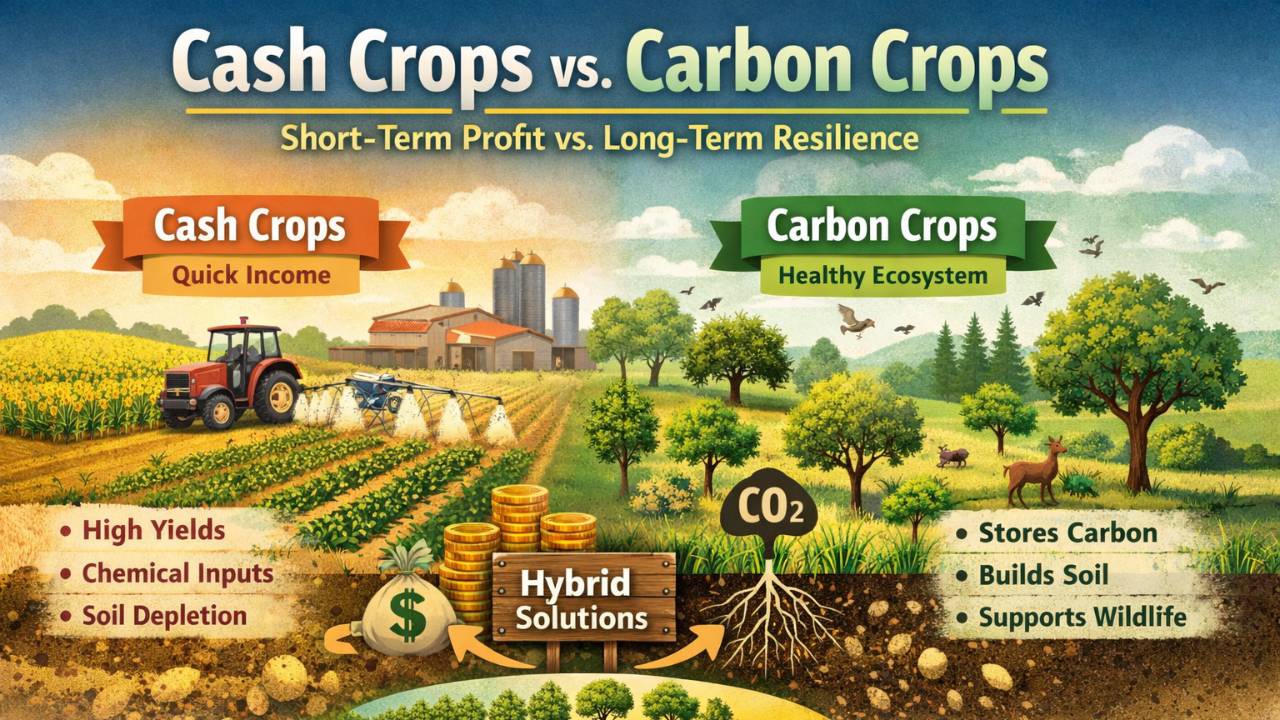
Regenerative agriculture starts with a simple shift in thinking: land is not just a production asset, it is a living system. Instead of focusing only on short-term yields, regenerative agriculture works to rebuild soil health, store carbon, improve water cycles, and strengthen long-term farm resilience—while still producing food and income. As climate pressure, input costs, and market volatility increase, regenerative agriculture offers a practical path forward by aligning profitability with ecological restoration rather than extraction.
If you manage land, farm it, invest in it, or advise people who do, you already know the first question that usually gets asked:
“What will make money this year?”
That question has shaped modern agriculture for decades. It’s why corn, soy, wheat, and oil palm dominate landscapes around the world. These are cash crops—fast-growing, predictable, and market-driven.
But there’s another category of crops that gets far less attention, even though they may determine whether agriculture is still viable 20–50 years from now.
These are carbon crops.
Understanding the difference between cash crops and carbon crops—and how to balance them—is one of the most important shifts happening in agriculture today.
What Are Cash Crops?
Cash crops are grown primarily for short-term income.
Think:
- Corn
- Soybeans
- Wheat
- Rice
- Oil palm
- Cotton
They are optimized for:
- High yields
- Mechanization
- Fertilizer response
- Seasonal predictability
In the right year, they work very well. They produce revenue quickly and fit neatly into existing markets.
The problem isn’t that cash crops exist.
The problem is what happens when they dominate entire systems.
The Hidden Cost of Short-Term Profit
Cash-crop systems are extractive by design. Nutrients are removed from the soil every season, and that loss has to be replaced—usually with synthetic inputs.
Over time, this leads to:
- Declining soil organic matter
- Compacted soil structure
- Increased runoff and erosion
- Greater dependence on fertilizers and chemicals
These costs don’t show up immediately on a balance sheet. They show up years later as:
- Lower resilience to drought
- Higher input costs
- More yield volatility
- Increased financial risk
This pattern is well documented by organizations like the FAO and NRCS:
- FAO SOILS PORTAL | Food and Agriculture Organization of the United Nations
- Soil Health | Natural Resources Conservation Service

What Are Carbon Crops?
Carbon crops are plants that build soil and store carbon over time.
Examples include:
- Trees and shrubs
- Perennial grasses
- Cover crops
- Deep-rooted legumes
- Agroforestry species
These crops do several things at once:
- Pull carbon from the atmosphere
- Store it in biomass and soil
- Improve soil aggregation
- Increase water-holding capacity
- Support biodiversity
The key difference?
Carbon crops create value slowly—but they create durable value.
Why Carbon Crops Are Often Ignored
Carbon crops don’t usually pay in the first season. Trees take years. Perennials take patience. Soil health improves gradually.
Most agricultural markets are not structured to reward:
- Long-term resilience
- Carbon storage
- Ecosystem services
As a result, many landowners feel trapped in a short-term loop:
“I know this isn’t ideal, but I need cash flow.”
That tension is real—and it’s why regenerative transitions often stall without support.
The Trade-Off Becomes Obvious at Scale
When you zoom out from a single field to an entire watershed or region, patterns become clear.
Cash-crop-dominated landscapes tend to have:
- Lower soil organic matter
- Higher flood and runoff risk
- Reduced biodiversity
Carbon-oriented landscapes tend to:
- Store more carbon
- Retain water longer
- Recover faster from drought
- Support pollinators and wildlife
Research summarized by Project Drawdown and the Rodale Institute shows that regenerative systems can outperform conventional systems over time—especially under climate stress:
- Regenerative grazing is overhyped as a climate solution. We should do it anyway. | Project Drawdown®
- Science – Rodale Institute
Hybrid Systems: Where the Real Opportunity Lives
This is not an “either/or” decision.
Many farmers are blending cash crops and carbon crops through:
- Agroforestry
- Silvopasture
- Intercropping
- Cover cropping
- Managed grazing
These hybrid systems:
- Maintain income
- Build soil
- Reduce risk
- Improve long-term profitability
They do require better planning. Poor design can reduce yields if plants compete for light, water, or nutrients. But well-designed systems create stacked benefits instead of trade-offs.
Markets Are Starting to Catch Up with Regenerative Agriculture
Slowly, incentives are changing.
Carbon markets, ecosystem service payments, and sustainability premiums are beginning to reward regenerative practices.
Examples include:
- Voluntary carbon markets
- Corporate sustainability supply chains
- Government soil-health programs
These mechanisms don’t replace cash flow—but they can tilt the economics enough to make regenerative systems viable sooner.
The Bottom Line
Cash crops aren’t bad. Carbon crops aren’t magic.
But ignoring the difference between short-term revenue and long-term resilience is no longer an option.
Land that only produces cash today may cost more tomorrow.
Land that builds carbon quietly compounds value over time.
The future of agriculture belongs to those who learn how to integrate both.
Start Your Regenerative Agriculture Transition Today!
If you are:
- A farmer thinking about transition
- A landowner managing risk
- An advisor, investor, or educator
- Or simply someone who cares about food, soil, and climate
You don’t have to figure this out alone.
Explore practical regenerative insights, real-world examples, and ecolonomic thinking at:
eatcommunity.com
Our focus is simple:
Making a little money while making the planet better.
Sources & Further Reading
- FAO – Soil Health and Carbon
FAO SOILS PORTAL | Food and Agriculture Organization of the United Nations - USDA NRCS – Soil Health Principles
Soil Health | Natural Resources Conservation Service - Rodale Institute – Regenerative Organic Research
Science – Rodale Institute - Project Drawdown – Regenerative Agriculture
Drawdown® Explorer | Project Drawdown® - IPCC – Climate Change and Land Use
Special Report on Climate Change and Land — IPCC site