
How Farming Without Fertilizer Is Shaping the Future of Agriculture
Apr 15, 2026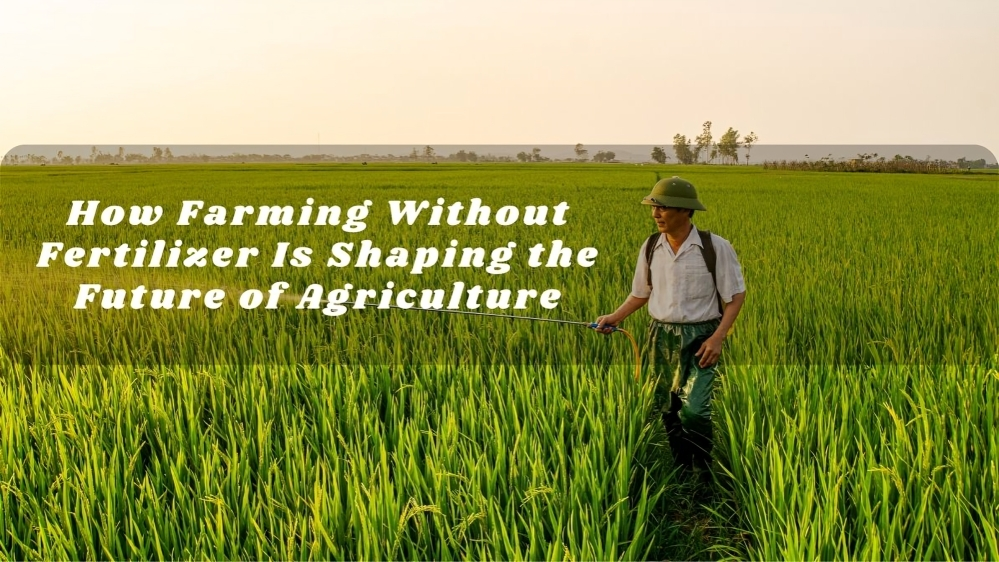
For decades, modern agriculture has depended heavily on synthetic fertilizers. Farmers have used nitrogen, phosphorus, and potassium to replace lost nutrients and keep crop yields high. However, a growing number of people are asking a different question: what if farms could stay productive by building fertility naturally instead of buying it in bags?
That question is becoming more important every year.
As fertilizer prices rise and concerns about soil health continue to grow, more farmers are looking for ways to reduce outside inputs. Fortunately, farming without synthetic fertilizer is not just an idealistic idea. In many systems, it is a practical approach that can improve long-term resilience, lower costs, and strengthen the land itself.
In other words, the future of agriculture may depend less on feeding crops directly and more on feeding the living system that supports them.
Nature Already Knows How to Recycle Nutrients
To begin with, natural ecosystems do not rely on synthetic fertilizer. Instead, nutrients move in cycles. Plants absorb nutrients from the soil, and then, when leaves fall or plants die back, those nutrients return to the ground through decomposition. As organic matter breaks down, it becomes available again for future plant growth. The Food and Agriculture Organization explains that soil organic matter plays a major role in nutrient cycling and that maintaining this cycle depends on balancing organic matter additions with plant uptake and losses from erosion or leaching. Learn more from FAO.
That is exactly the principle behind fertilizer-free farming.
Rather than relying mainly on external inputs, farmers can return crop residues, compost, manure, and other organic materials to the soil. As a result, nutrients are reused within the farm system instead of being constantly replaced from outside sources.
Healthy Soil Depends on Living Biology
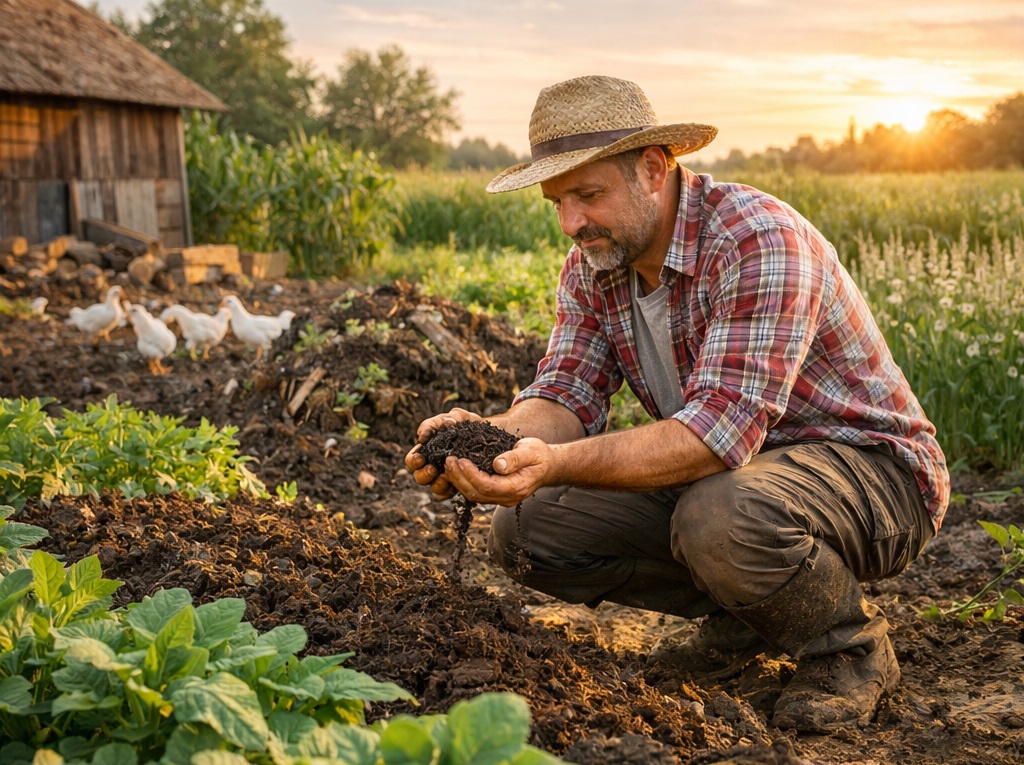
At the same time, soil is not just dirt. It is a living ecosystem filled with bacteria, fungi, insects, worms, and countless other organisms. These organisms help break down organic matter, support soil structure, and drive nutrient availability. According to the FAO Soil Biodiversity Portal, soil organisms are primary drivers of nutrient cycling and help improve nutrient acquisition by plants.
Because of this, fertilizer-free farming depends heavily on protecting soil life.
When farmers reduce unnecessary disturbance, add organic matter, and keep living roots in the ground, they help build the biological engine that makes natural fertility possible. Therefore, the health of the soil community becomes just as important as the health of the crop.
Nitrogen Can Be Built Naturally
Of all the nutrients crops need, nitrogen is often the most limiting. That is why synthetic nitrogen fertilizer became so central to industrial farming. Even so, nature has its own nitrogen supply system.
Legumes such as peas, beans, clover, and alfalfa form partnerships with bacteria that can convert atmospheric nitrogen into forms plants can use. This process is known as biological nitrogen fixation. Nature Education’s Scitable and New Mexico State University both describe how legumes work with rhizobia bacteria in root nodules to supply usable nitrogen.
As a result, farmers can add fertility by including legumes in crop rotations, cover crop mixes, or intercropping systems. Not only does this help replace external nitrogen inputs, but it can also improve organic matter and soil structure over time. The USDA Natural Resources Conservation Service notes that legumes are especially valued in cover crop systems for nitrogen fixation, while USDA also highlights cover crops for capturing and recycling nutrients in the soil profile.
Different Plants Mine Different Soil Layers
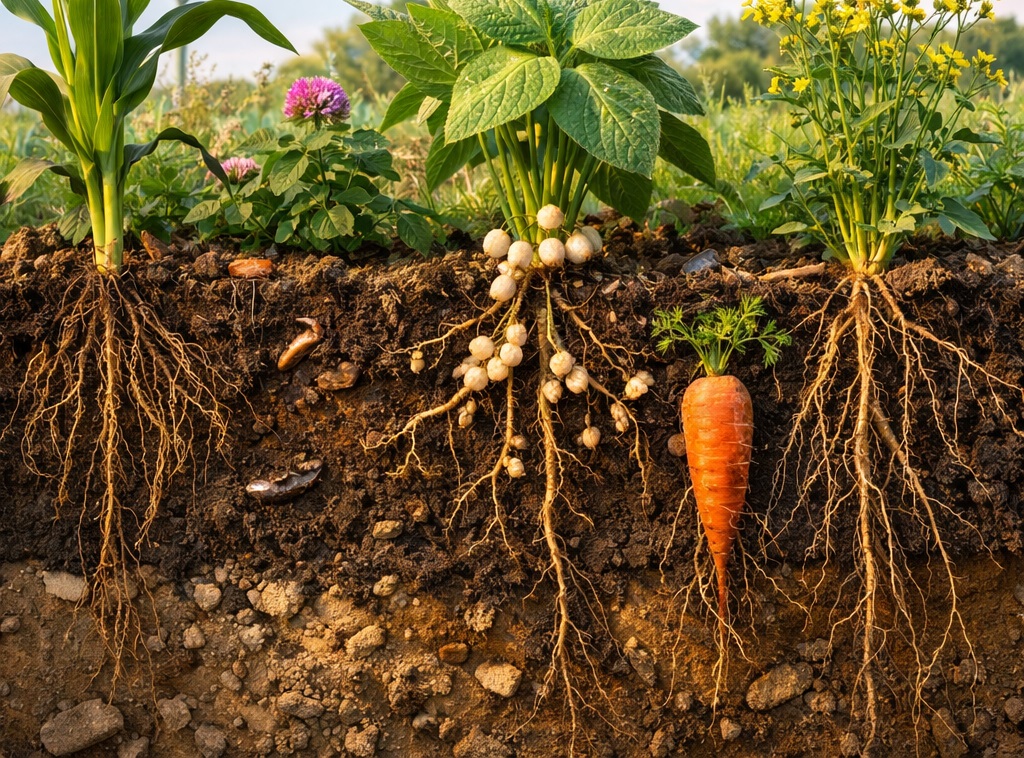
Another important part of fertilizer-free farming is plant diversity. Not all plants pull nutrients from the same depth. Some have shallow roots, while others reach much deeper into the soil.
This matters because deep-rooted plants can access minerals below the reach of shallow-rooted crops. Then, when those deep-rooted plants shed biomass or decompose, some of those nutrients are brought back closer to the soil surface. Over time, this helps redistribute fertility through the soil profile and strengthens the system naturally. SARE and USDA both describe mixed cover crop systems as a way to improve nutrient availability, organic matter, and soil function.
So, instead of depending on one crop and one nutrient strategy, diversified systems allow farms to make better use of what is already present in the soil.
Keeping Nutrients From Washing Away
Of course, it is not enough to build nutrients. Farms also have to keep them from leaving.
One of the biggest challenges in agriculture is nutrient loss through erosion, runoff, and leaching. If nutrients wash away faster than they are recycled, even the best biological system will struggle. That is why practices such as mulching, continuous ground cover, reduced tillage, and cover cropping are so important.
For example, Sustainable Agriculture Research and Education reports that cover crops help protect water quality by reducing erosion and cutting nitrogen losses, with a median reduction of 48% across multiple studies.
Likewise, the FAO emphasizes that soil restoration depends on maximizing the retention and recycling of nutrients while minimizing losses caused by leaching, runoff, and erosion. Read more here.
Therefore, fertilizer-free farming is not simply about what gets added. It is also about what gets protected.
The Transition Takes Time
It is important to be realistic. Farming without fertilizer is usually not an overnight shift. If a field has been managed for years with heavy external inputs, the biological systems needed for self-sustaining fertility may take time to rebuild.
During that transition, yields can sometimes dip. However, over time, soils with stronger organic matter, better biological activity, and more efficient nutrient cycling often become more stable and resilient. USDA notes that cover crops can improve soil health by reducing erosion, increasing organic matter, and improving air and water movement through the soil. See USDA’s overview.
So while the transition may require patience, the long-term payoff can be significant: lower input costs, healthier soil, and less dependence on unstable supply chains.
A Smarter Way to Think About Fertility
Ultimately, farming without fertilizer does not mean farming without nutrients. Instead, it means managing nutrients in a more ecological way.
Rather than treating the soil as an empty medium that needs constant chemical correction, this approach treats the farm as a living system. Organic matter is cycled back into the land. Soil biology is supported. Nitrogen is fixed through plant-microbe partnerships. Plant diversity is used to reach and recycle nutrients. And losses are reduced through protective practices.
That is a very different mindset.
Yet it may be one of the most important shifts agriculture can make in the years ahead.
Final Thoughts
The farms that succeed without synthetic fertilizer are usually the ones that understand one basic truth: healthy soil is not built by force. It is built by cooperation.
When farmers work with natural nutrient cycles instead of against them, they can create systems that are more productive over the long run, more cost-effective, and far more resilient.
In the end, the future of agriculture may belong to the farms that learn how to grow fertility from within.
Join the Sustainable Farming Conversation
Want to explore more practical ideas about sustainable farming, ecological systems, and building a better future through agriculture? Visit the EAT Community and discover insights, resources, and conversations designed to help you make a little money while making the planet better.
Related Articles & References:
- Food and Agriculture Organization of the United Nations. The importance of soil organic matter. https://www.fao.org/4/a0100e/a0100e04.htm
- Food and Agriculture Organization of the United Nations. Soil biodiversity. https://www.fao.org/soils-portal/soil-biodiversity/en/
- Food and Agriculture Organization of the United Nations. A key to soil restoration is to maximize retention and recycling of nutrients. https://www.fao.org/4/a0100e/a0100e02.htm
- Nature Education Scitable. Biological Nitrogen Fixation. https://www.nature.com/scitable/knowledge/library/biological-nitrogen-fixation-23570419/
- New Mexico State University. Nitrogen Fixation by Legumes. https://pubs.nmsu.edu/_a/A129/
- USDA Natural Resources Conservation Service. Diverse Cover Crop Mixes for Good Soil Health. https://nrcs.usda.gov/plantmaterials/nypmssy11419.pdf
- USDA. Cover Crops Provide Multiple Benefits, Higher Yields. https://www.usda.gov/about-usda/news/blog/cover-crops-provide-multiple-benefits-higher-yields
- Sustainable Agriculture Research and Education. Cover Crops for Sustainable Crop Rotations. https://www.sare.org/resources/cover-crops/
- Sustainable Agriculture Research and Education. Cover Crops at Work: Keeping Nutrients Out of Waterways. https://www.sare.org/publications/cover-crops-ecosystem-services/cover-crops-at-work-keeping-nutrients-out-of-waterways/
- USDA Natural Resources Conservation Service. Cover Crops Overview. https://www.nrcs.usda.gov/sites/default/files/2025-04/Cover_Crop_Overview-FS_0.pdf