
Strategies for Profitable Fish Species Selection for Aquaculture
Mar 13, 2026
If you want to make money in aquaculture, start with the right fish.
That decision shapes almost everything else: your feed costs, growth speed, survival rate, market demand, and day-to-day management. Choose the wrong species, and your costs can rise fast. Choose the right one, and you give yourself a much better chance to grow efficiently and sell profitably. Aquaculture already supplies more than half of the seafood produced for human consumption worldwide, so the opportunity is real—but species choice still makes or breaks the business.
Why species choice matters so much
Think of species selection as a business decision first, not just a biological one. You need to ask a few clear and practical questions. How fast is this fish likely to grow? How much feed will it need to reach market size? Will it survive well in your system and under your local conditions? And just as importantly, will buyers be willing to pay a price that makes the effort worthwhile? When you answer those questions early, you make it much easier to choose a species that supports both production success and profit.
In other words, profitability usually comes down to a few core factors working together: growth rate, feed conversion, survival, operating cost, and market value. When those lines are in place, your chances of building a resilient farm go up. Studies from FAO also emphasize that feed efficiency has a direct effect on profitability.
Look for species that grow fast and sell well
If you are looking for a practical starting point, tilapia often stands out.
Why? Because tilapia is widely farmed, adapts to many production systems, and is commonly favored for its suitability across a broad range of farming environments. It also benefits from extensive production knowledge and established markets in many parts of the world.
Catfish can also be a strong choice, especially when you want a hardy species with dependable demand in many markets. Carp remains important in lower-input systems and in price-sensitive markets, where affordability matters. Meanwhile, salmon can command a higher selling price, but it usually requires more sophisticated systems, tighter environmental control, and significantly higher investment. NOAA notes the importance of matching species and systems carefully, and highlights the specialized nature of marine aquaculture, such as Atlantic salmon production.
So the message is simple: do not ask only, “What fish is popular?” Ask, “What fish fits my farm and my buyers?”
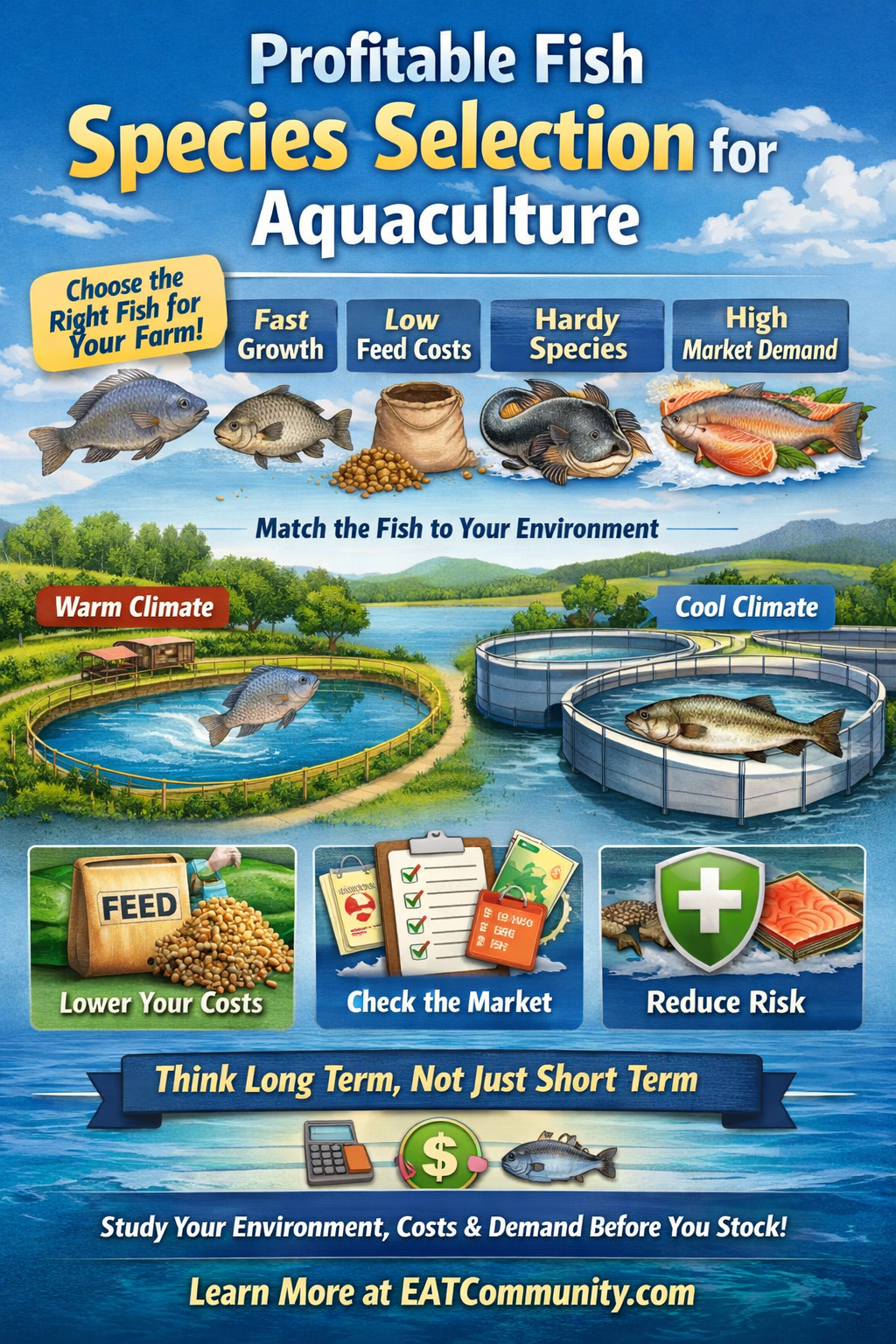
Match the fish to your environment
Next, be honest about your conditions.
If you are in a warm region, species such as tilapia often make more sense. If you are working in cooler water, trout or salmon may be better options. Water temperature, oxygen levels, water supply, and energy costs all matter. NOAA’s regional aquaculture materials make this point clearly: different ecosystems support different farmed species and production methods.
So instead of forcing the environment to suit the fish, choose fish that already fit the environment you have.
That one move can reduce your spending on heating, aeration, filtration, and system correction. As a result, your operation becomes easier to manage and more profitable over time. FAO climate-related work on tilapia also shows that changes in feed cost, mortality, and fish price can sharply affect profitability, which reinforces the importance of environmental fit and risk planning.
Do not ignore the market
Now let’s make this practical: a fish that grows well but does not sell well is still a bad business choice.
Before you stock ponds, tanks, or cages, talk to buyers. Check local prices. Talk to restaurants, wholesalers, retailers, and processors. Learn what sizes they want, what species move steadily, and what customers already recognize.
This matters because stable demand is often more valuable than trendy demand. If you can sell consistently, you reduce risk. World Bank aquaculture research also points to the importance of operating costs, input use, and market structure in determining sector performance and profitability.
So say it this way: “I am not just raising fish. I am producing a product for a market.”
That mindset helps you make better decisions from the beginning.
Watch feed costs closely
Feed is usually your biggest expense.
Because of that, feed conversion ratio is not just a technical metric—it is a profit metric. A species that turns feed into body mass more efficiently can give you a real financial advantage. FAO feed-management publications on tilapia repeatedly stress that feed performance and feed conversion are central to farm economics.
This is one reason herbivorous and omnivorous species are often attractive to producers. In many cases, they are less expensive to feed than carnivorous species that depend more heavily on high-protein inputs.
So when you compare species, do not stop at selling price. Ask, “How much will it cost me to grow each kilogram?”
That is the number that protects your margin.
Choose species that help you reduce risk
If you are new to aquaculture, hardier species are often the smarter choice.
Fish that tolerate handling, crowding, and fluctuations in water quality can help reduce losses. Lower mortality means more predictable harvests, steadier cash flow, and fewer expensive surprises.
That does not mean premium species are bad choices. It means you should match complexity to your level of experience, infrastructure, and available capital. High-value fish can be profitable, but only when the production system is ready for them. NOAA’s aquaculture guidance and regional materials both support the idea that species choice should reflect the production environment and management capacity.
Think long term, not just short term
In the end, the most profitable aquaculture businesses usually do not chase hype. They build around fit.
They look at the whole picture: environment, feed cost, survival, infrastructure, labor, and buyer demand. Then they choose the species that balances those factors best.
That is the real strategy.
Do not ask only, “What fish makes the most money?” Ask, “What fish gives me the best chance to grow well, survive well, and sell well in my actual situation?”
That is how you build an aquaculture operation that can scale, stay resilient, and keep generating returns over time.
Make Your Aquaculture Business More Profitable
If you want your aquaculture business to be more profitable, do not guess on species selection.
Take time to evaluate your water conditions, climate, feed costs, infrastructure, and local buyer demand before you stock your system. Then choose the species that fits your farm financially and biologically.
For more practical insights on aquaculture, sustainability, and ecolonomic strategies, visit the Ecolonomics Action Team at EAT Community.
I can also turn this into a stronger SEO blog version with a focus keyword, meta description, internal link suggestions, and subheadings optimized for WordPress.
Related Articles and References
- NOAA Fisheries — Aquaculture overview
- NOAA Fisheries — Aquaculture references and further reading.
- NOAA Fisheries — Atlantic Salmon: Aquaculture.
- NOAA Fisheries — Aquaculture outreach materials and regional fact sheets.
- FAO — Markets for Tilapia.
- FAO — On-farm feed management practices for Nile tilapia.
- FAO — Improvement of tilapia seed production and grow-out culture management.
- FAO — Economics of aquaculture feeding practices in selected Asian Countries.
- World Bank — Fish to 2030: Prospects for Fisheries and Aquaculture.
- World Bank — The Global Aquabusiness Investment Guide.